
Google Ads Lead Generation Case Study for Lazy Susan’s Cleaning Service
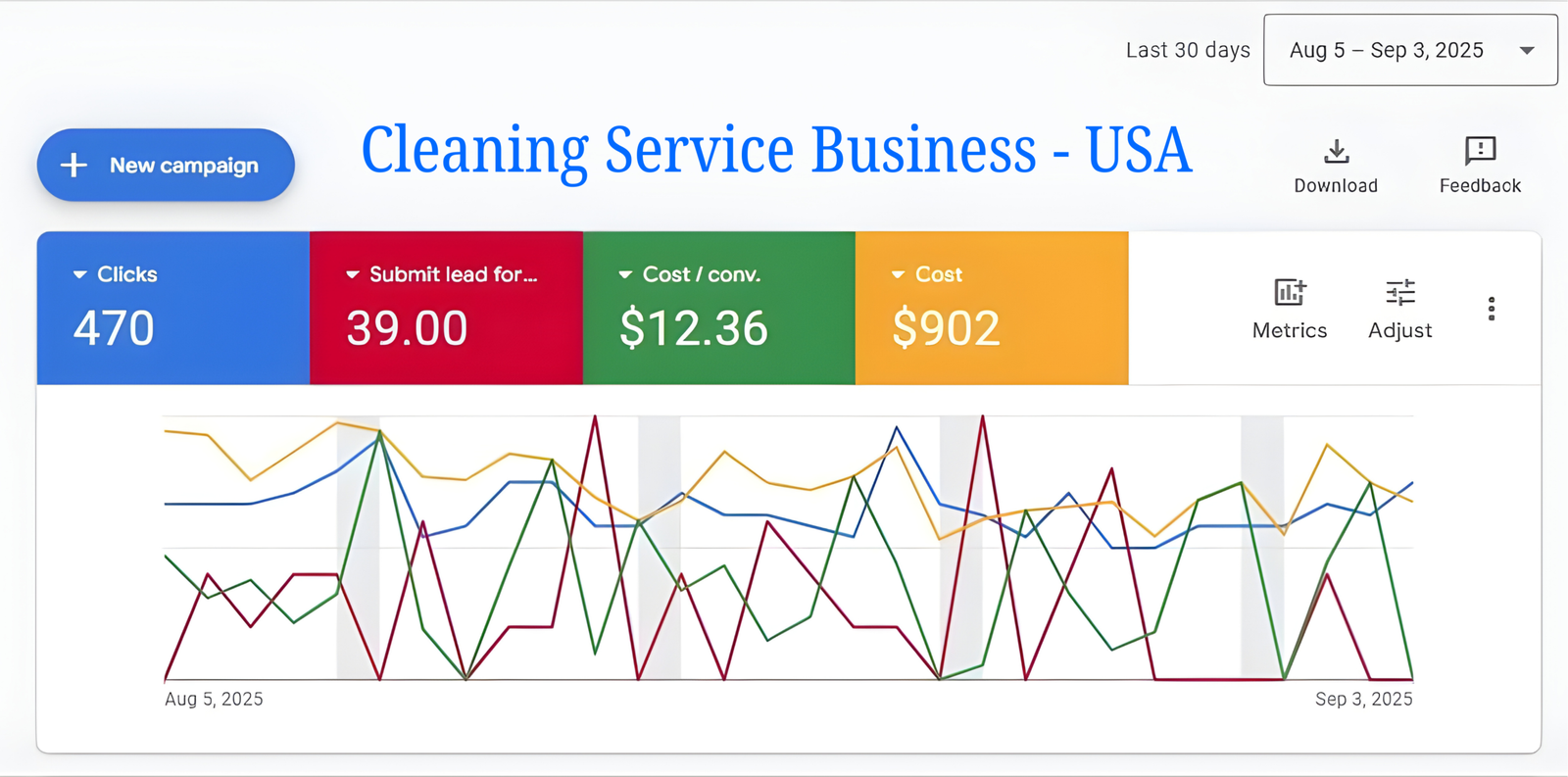
Lazy Susan’s Cleaning Service is a U.S.-based professional cleaning company offering residential and commercial cleaning services. The business operates in a highly competitive local market where customers often search with immediate intent to book cleaning services.
The company’s growth depends heavily on generating consistent inbound leads from users actively searching for cleaning services, rather than general awareness or low-intent traffic.
Before optimization, Lazy Susan’s Cleaning Service faced common challenges seen in local service Google Ads accounts:
- High competition on core cleaning keywords
- Inconsistent lead volume week to week
- Budget wasted on low-intent or research-based searches
- No predictable cost per lead for scaling decisions
The goal was not to increase traffic volume, but to generate high-intent leads from users ready to book a cleaning service.
- Generate consistent, qualified cleaning service leads
- Keep cost per lead affordable and predictable
- Focus budget only on high-intent local searches
- Create a scalable Google Ads structure for long-term growth
We started by researching how customers search for cleaning services locally. Keywords were grouped by specific services such as house cleaning, apartment cleaning, move-in/move-out cleaning, and recurring cleaning.
Campaigns were strictly limited to Lazy Susan’s service areas, ensuring ads only appeared to users with immediate local intent.
Lead submission tracking was implemented as the primary conversion action. Ad copy and extensions were optimized to encourage fast inquiries from ready-to-book customers.
Informational and low-commercial-intent searches were continuously excluded. This protected the ad budget and improved overall lead quality.
The campaign delivered consistent, high-quality leads at a competitive cost per conversion. By focusing on service-specific and local intent, Lazy Susan’s Cleaning Service achieved predictable lead volume without increasing ad spend aggressively.
This allowed the business to confidently plan staffing and service capacity while maintaining profitability.